Sheilas sjakkskole
Sjakktrening for alle nivåerTaggsky
Book tip: Together with Mamedyarov
Together with Mamedyarov is written by Alexey Kuzmin. All the exercises are, of course, based on games by Shakhriyar Mamedyarov. The book is not brand new — it was published in 2020 — but I’ve only just found the time to read it :P
I have long been a fan of Mamedyarov’s courageous sacrifices and intuitive king attacks, but this book presents a more nuanced picture. He became World Junior Champion in 2003, and his peak rating of 2820 is the sixth highest in history. Naturally, he possesses enormous strategic strength. The game annotations also offer insight into his development as a chess player. They provide a deeper understanding of how a top player matures and gradually expands his repertoire.
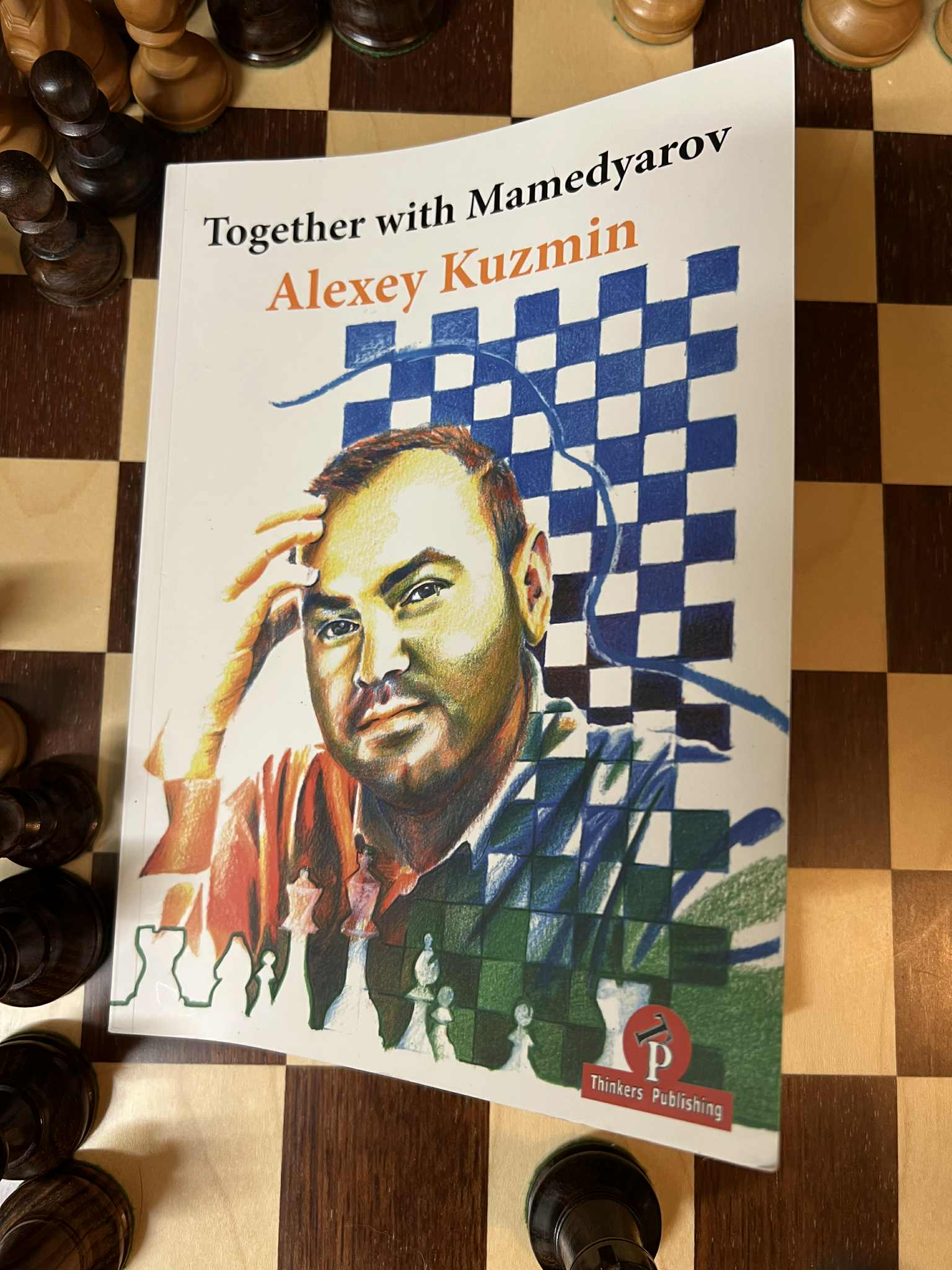 Unlike many other books, the solutions are not placed directly below the diagram. This allows you to work on the position with full concentration, without your eyes being drawn toward the answer. I am quite tired of otherwise excellent chess books where I have to cover half the page with paper or napkins to avoid seeing the solution.
At the same time, this is not a traditional tactics collection. The exercises are not typical “mate in three” problems, they are not organized by theme, and there are no leading instructions hinting at the solution. Most often, you are simply asked to find the best continuation — exactly as in your own games.
This makes the book particularly well suited for training decision-making. You will often need to evaluate who stands better before searching for the concrete move. I recommend actively using the exercises to train candidate moves: identify several realistic alternatives, compare them carefully, and finally commit to a clear decision. It is this process — more than whether you find the correct move — that produces the greatest learning effect.
The solutions are also unusually rich in content and easy to read. A typical solution spans one to two full pages and offers far more than just the correct continuation. Often, it explains what happened later in the game, which plans are critical, and why alternative ideas fail. Each exercise thus becomes a small lesson in practical chess understanding.
The book also includes a scoring system. You receive points for correct evaluation of the position and for finding the right series of moves — rarely is one move enough to score points. The points can be totaled to give an indication of the rating level your work corresponds to. The points themselves are not essential, but they can serve as motivation, particularly if you are training with others — for example, in a friendly competition with a training partner.
The book is divided into two sets of exercises with solutions:
80 exercises for players rated approximately 1400–1900
90 exercises for players rated approximately 1700–2100
The rating ranges should be taken with a grain of salt. It depends greatly on your prior experience with solving exercises and analytical training, and on how established your rating is.
I recommend spending 3–10 minutes per exercise. This makes the book ideal for bite-sized training: short, focused sessions of the highest quality you can manage, while still fitting into everyday life — a training format I am a strong supporter of. If you are not close to the correct answer after ten minutes, you will nevertheless have invested enough thought in the position to benefit significantly from studying the explanation.
An additional advantage is that the book can easily be read without a chessboard. If the solution is lengthy, sufficient auxiliary diagrams are included.
In short
This is a chess book I can warmly recommend to a reasonably active club player who wants to improve analytical skills and train positional understanding. The examples are well chosen, appropriately challenging, and instructive. At the same time, you become better acquainted with Azerbaijan’s strongest player.
It is not your first chess book, and you will not learn strategic or tactical themes in a systematic way. Nor can it function as a reference work for specific themes or position types encountered elsewhere.
Kommentarer
Bloggnavigasjon
Matchende innlegg
2026 (6)
2025 (18)
desember (1)
november (1)
oktober (1)
september (3)
juli (1)
juni (4)
februar (3)
2024 (26)
desember (2)
oktober (1)
september (1)
august (3)
juli (3)
juni (4)
mai (3)
april (4)
mars (3)
2023 (20)
desember (2)
november (2)
oktober (1)
september (1)
august (1)
april (1)
mars (8)
- Dagsavisen lørdag 25. mars
- Ny funksjonalitet: SPILLETRENEREN, tren fra VALGFRI stilling mot Stockfish på nivå 0-20
- Sjakkfestival på The Good Knight 25. og 26. mars
- Dagsavisen lørdag 18. mars
- Dagsavisen lørdag 11. mars
- Arbeid med den store basen vil føre til ustabilitet i helga
- Bruksanvisning på trekkterperen
- Perpetual chess podcast